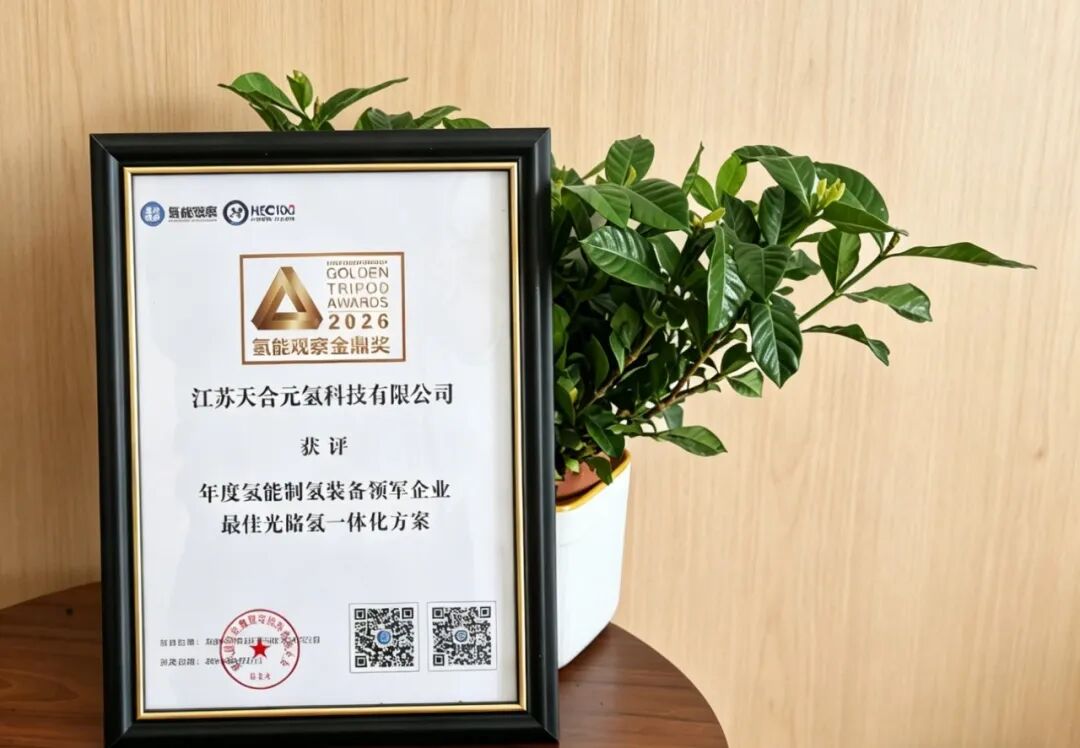
On April 22, the results of the 2026 Hydrogen Energy Industry "Golden Bell Award" were officially announced. As one of the earliest companies in the industry to adopt photovoltaic-hydrogen integrated solutions, Trina Hydrogen won the Best Photovoltaic-Hydrogen Integrated Solution Award for Leading Hydrogen Energy Enterprises. This accolade not only reflects the industry's high recognition of Trina Hydrogen's technical capabilities and practical achievements but also marks its entry into the top tier of the zero-carbon energy solution sector, injecting strong momentum into the energy transition.
As the core sector of Trina Group's zero carbon industry chain of "photovoltaics+energy storage+hydrogen energy", Trina Green Hydrogen relies on the group's deep accumulation in the fields of photovoltaics and energy storage to accurately grasp industry pain points such as intermittent consumption difficulties of new energy, large long-term energy storage gaps, and slow penetration of high-value scenarios. It creates an efficient, stable, and economical integrated solution for photovoltaics and hydrogen storage, which can achieve a leap in energy utilization efficiency of "1+1+1>3".
The core advantage of integrated photohydrogen storage lies in the triple innovation of energy utilization efficiency, supply stability, and low-carbon value. At the level of efficient consumption, the three-level coordinated regulation of photovoltaic, energy storage, and hydrogen energy converts excess green electricity that is difficult to consume in the power grid into green hydrogen through electrolysis of water, turning "abandoned electricity" into "clean energy carriers". The energy consumption rate is close to 100%, allowing every ray of sunshine to fully release its value. At the level of stable supply, energy storage is responsible for short-term voltage and frequency regulation at the second and minute levels, while hydrogen energy undertakes the responsibility of cross seasonal and long-term energy storage. Electricity and hydrogen complement each other, combining long and short-term energy storage, and flexibly switching between off grid and grid connected modes. The reliability of power supply can reach 99.99%, completely eliminating the dilemma of "relying on the weather to eat" for new energy.
At the level of low-carbon economy, this plan has zero carbon emissions throughout its entire lifecycle. Green hydrogen can be directly used in difficult to reduce emissions areas such as steel smelting, chemical synthesis, transportation, and shipping, helping the industrial sector to deeply decarbonize. At the same time, through multiple benefits such as self use, peak valley arbitrage, and hydrogen energy appreciation, it significantly reduces the cost of energy supply throughout the entire lifecycle, allowing zero carbon development to have both environmental and economic benefits. Based on the self-developed Tianqing series electrolytic cells and intelligent energy management system, the solution can optimize the operation status of photovoltaic, energy storage, and hydrogen production equipment in real time, respond to power fluctuations in milliseconds, ensure continuous and stable operation of the hydrogen production process, significantly reduce unit comprehensive energy consumption, and provide reliable technical support for the large-scale production of green hydrogen.
At present, the global carbon neutrality process is accelerating, and the green hydrogen industry is entering a critical period of large-scale development. As the ultimate form of comprehensive energy services, the integration of photovoltaic hydrogen storage has become the direction of infrastructure development in parks, industrial and commercial areas, ports, mining areas and other scenarios. Looking towards the future, Trina Hydrogen will take this award as an opportunity to continue to deepen the innovation of integrated solar hydrogen storage technology, continuously optimize solutions, improve product performance, accelerate the reduction of green hydrogen costs and the implementation of scenarios, work together with industry chain partners to build a zero carbon industrial ecosystem, and contribute greater strength to the realization of China's "dual carbon" goals and global energy transformation.